
Glass Hob Buying Guide: 9 Smart Things to Consider Before You Buy
Buying a hob in Pakistan looks simple until you hit the real questions: Will it fit your countertop cutout? Should you choose gas or electric? How many burners (or zones) do you actually need for daily cooking? And in Karachi specifically, where gas pressure, ventilation, and after-sales support can make or break the experience, choosing the wrong model becomes expensive very quickly.
This glass hob buying guide is written for Pakistani kitchens with practical, decision-making steps (not generic advice). You’ll learn how to choose glass hob size and layout, understand hob power ratings, compare built-in vs freestanding, and use a clear hob cutout guide mindset so you don’t end up with a “fitment problem” on installation day.
You’ll also see a clean buying checklist at the end (printable), plus FAQs that answer the exact questions people ask before buying. And when you’re ready to shortlist models, Xperts can help you match the right hob to your Karachi kitchen layout, countertop type, and service requirements—so the content leads naturally from information to a confident purchase.
Glass hob buying guide
A glass hob is usually chosen for its sleek look, easy wipe-clean surface, and modern kitchen feel. But the “right” glass hob depends on three things:
- Your size & layout (cutout + countertop compatibility)
- Your cooking style (burners/zones, controls, power)
- Your support plan (warranty and service, parts availability)
Use the steps below as your complete glass hob checklist.
Decide size & layout
1) Start with a “kitchen hob layout” plan (not just a product photo)
Before you look at designs and finishes, map your cooking routine:
- Do you cook 2 dishes at once or 4–5 items together (daal + roti + sabzi + chai)?
- Do you use large pots (degchi/handi) often?
- Is your counter space tight (common in Karachi apartments)?
This simple layout thinking prevents you from buying a hob that looks right but feels cramped daily.
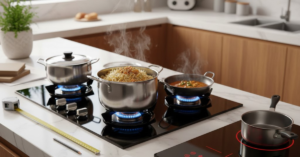
2) Choose glass hob size based on real cookware, not guesswork
Glass hob sizes typically range from compact 60 cm to wider 75–90 cm options (varies by model). A bigger hob is not always better if your counter and ventilation cannot support it.
Choose glass hob size using these practical checks:
- Measure your largest pot diameter and make sure it won’t clash with adjacent burners/zones.
- Check the distance between burners: close spacing causes heat overlap and uncomfortable handling.
- Confirm you still have prep space beside the hob.
3) Use a hob cutout guide mindset: cutout ≠ outer size
Most buyers only measure the surface size. The installer cares about the cutout size (the hole in the countertop). That’s why a hob cutout guide is essential.
Hob cutout guide essentials:
- Cutout width and depth must match the model spec (do not “adjust later”).
- Confirm countertop thickness requirement.
- Check under-counter clearance for gas pipe routing or electrical box clearance (for electric hobs).
This single step prevents the most common Pakistan-wide mistake: buying first, then forcing a bad fit.
4) Built-in vs freestanding: which is better for Karachi homes?
Built-in vs freestanding comes down to installation style and how permanent you want the setup to be.
Built-in (recommended when possible):
- Cleaner look
- Better stability
- Less movement on the counter
- More “premium kitchen” feel
Freestanding (useful if):
- You’re in a rental and want easy relocation
- You expect frequent kitchen changes
- You want minimal countertop cutting
If you’re planning a full built-in kitchen, built-in wins—just make sure your cutout and support are planned correctly.
Power, zones, and controls
5) Number of burners or zones: pick based on daily reality
This is where most people overspend.
Number of burners (gas hobs):
- 2 burners: best for small kitchens, minimal cooking
- 3 burners: good balance for small families
- 4 burners: ideal for regular family cooking and hosting
- 5 burners: only worth it if you truly cook multiple items daily
How many zones should a hob have? (electric hobs):
- 2 zones: compact and efficient
- 3–4 zones: better for serious multi-dish cooking
- Consider a dual/expandable zone if you use larger cookware
6) Gas vs electric considerations (Pakistan-specific)
In Pakistan, this decision is not only about preference—it’s also about reliability and cost patterns.
Gas hob (glass gas hob) strengths:
- Familiar cooking feel (especially for desi cooking)
- No dependency on heavy electrical load
- Quick heat control with flame
Electric hob strengths:
- Very clean look
- Easier wipe-clean experience
- Often paired with safety features (child lock, timers)
Karachi reality check:
- Gas pressure fluctuations can affect flame stability.
- Electric hobs require stable wiring, good earthing/grounding, and suitable load capacity.
So the best answer is not “gas is better” or “electric is better”—it’s matching the hob to your home’s actual utilities.
7) Hob power ratings: what to look for before buying
Many buyers ignore hob power ratings, then wonder why cooking feels slow (or why the unit trips the circuit).
For gas hobs:
- Look at burner output levels (high + medium + simmer options).
- A strong wok burner (triple ring) matters if you do heavy sautéing.
For electric hobs:
- Confirm total wattage and your circuit’s capacity.
- If your home wiring is older, confirm compatibility before purchase.
- This is also where glass hob electrical needs matter—don’t assume “plug and play.”
If you’re unsure, Xperts can guide you to models that match typical Karachi kitchen electrical realities and recommend installation requirements up front.
8) Hob controls guide: knobs vs touch (and what touch control actually is)
People often ask: “What is touch control?”
Touch control means the hob is operated via a touch panel (usually on electric/induction models). Instead of turning a knob, you tap to adjust heat levels, timers, and safety locks.
Hob controls guide (practical comparison):
- Knobs (common in gas glass hobs): simple, fast, familiar
- Touch control (electric hobs): modern, precise, often includes safety locks and timers
Choose controls based on who cooks at home:
- If elders or domestic help frequently use the hob, knobs can be simpler.
- If you want a modern interface and safety locking, touch control is valuable.
9) Cooktop finishes and glass quality: what matters in daily cleaning
Not all “glass hobs” behave the same.
Best glass hob features to look for:
- Tempered glass with good heat resistance
- Strong edge finishing (chips and corner damage are common in busy kitchens)
- Dark glass usually hides stains better, but fingerprints show more
- Verify if the glass is designed for high heat cycles (especially gas flame exposure)
Installation considerations
Your choice must match your countertop and installation realities—especially in Karachi where granite/marble is common and cutout work is expensive.
Countertop compatibility: does glass hob need special countertop?
A glass hob doesn’t always need a “special” countertop, but it does need the right conditions.
Hob countertop compatibility checklist:
- Countertop must be strong and stable (granite/marble usually works well)
- Cutout must be clean and exact
- Proper sealing to prevent water/oil seepage
- Under-counter clearance for gas piping/electric box
For built-in hobs, link internally to your installation guide (Article 4):
Anchor: countertop deep fryer fitting / installation guide is for fryer articles; here, use a hob-specific anchor like glass hob installation guide (Article 4 in your Cooking Hobs cluster).
Safety features to prefer (especially for families)
When you evaluate models, include safety features as a buying factor—not an afterthought:
- Flame failure device (gas)
- Child lock (touch control)
- Residual heat indicator (electric)
- Auto shut-off/timer functions (electric)
After-sales & warranty
In Pakistan, after-sales support is part of the product. A strong warranty on paper means little if parts and service are hard to access.
Warranty and service: what to verify before paying
Use this mini-check:
- Warranty duration and what it covers (glass, burners, valves, panel)
- Warranty terms (what voids it—wrong installation, voltage issues, etc.)
- Service coverage in Karachi and response time
- Availability of spare parts and burners/igniters
- Support channel clarity (phone/WhatsApp/service center)
These are critical warranty terms checks, not “extra details.”
If your site has an after-sales policy page or a dedicated service page, this is a natural internal link point. Menas Xperts should also be positioned here as a safer buying choice because they can guide selection and help ensure correct installation practices (which protects warranty validity).
Conclusion
A smart purchase starts with a practical glass hob buying guide approach: measure cutouts correctly, match glass hob sizes to your kitchen layout, select the right number of burners or zones, and confirm hob power ratings and control type before paying. In Karachi, it’s equally important to verify warranty and service, because long-term satisfaction depends on parts availability and support quality—not just looks.
If you want to shortlist the best glass hob features for your budget and kitchen conditions, Xperts can help you choose the right model, confirm sizing and countertop compatibility, and guide you toward a purchase that installs cleanly and stays reliable for years.
FAQs (People Also Ask)
1.How to choose a glass hob?
Start with your kitchen hob layout and daily cooking needs. Then choose the right size and cutout match, decide burners/zones, and compare controls and power ratings. Finally, verify warranty and service coverage in Karachi. This glass hob buying guide approach prevents wrong fit and poor support issues.
2. What size glass hob do I need?
Choose glass hob size based on your countertop space, cutout requirements, and cookware size. In Pakistani kitchens, burner spacing matters as much as surface width. Always check the manufacturer cutout spec—this is where a proper hob cutout guide prevents expensive rework.
3. Does glass hob need special countertop?
Not always, but it needs correct countertop thickness, stable support, exact cutout, and proper sealing. Granite and marble are common in Karachi and often work well, but the cutout must be precise and there must be enough clearance below for safe installation.
4. How many zones should a hob have?
For electric hobs, 2 zones suit compact kitchens; 3–4 zones suit families who cook multiple dishes together. If you frequently use large cookware, consider an expandable zone. Match zones to your cooking routine, not to “maximum features.”
5. What is touch control?
Touch control is a panel-based control system (common on electric/induction hobs) where you tap to set power levels and timers, often with child lock and safety features. If ease-of-use for elders is important, compare touch control carefully against knob controls.